Этот материал пока доступен только на языке: английский — перевод ещё не готов.
Three Capitals Flew to Tehran. Washington Was Not in the Room.
A Saudi prince, a Pakistani army chief and a Turkish spymaster sat with Pezeshkian while Trump called the summer ceasefire a waste of time. The off-ramp is being built without the

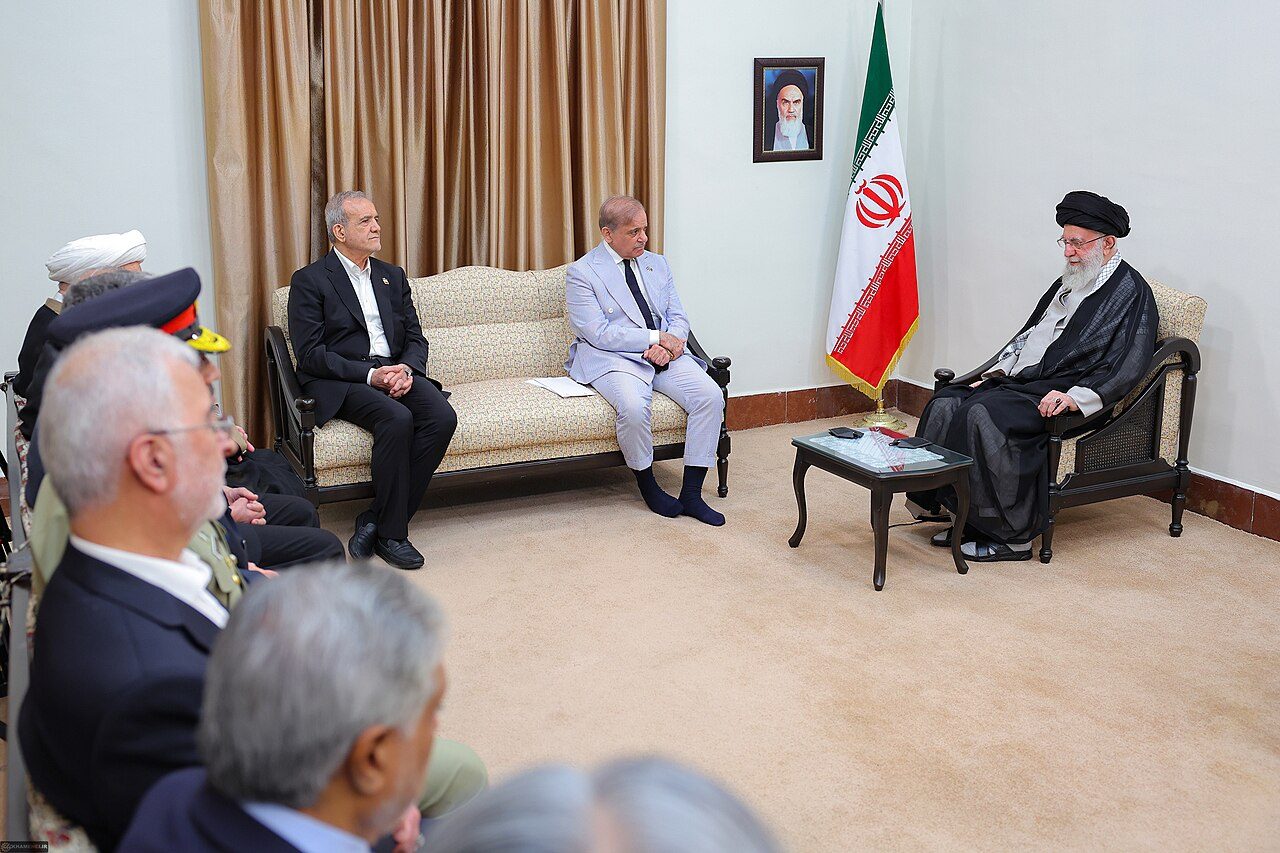
On Monday a Saudi defence minister, a Pakistani army chief and the head of Turkish intelligence sat in a room in Tehran with the Iranian president, and no American was present. That sentence, read alone, tells you where the war has gone.
The meeting was not symbolic. Prince Khalid bin Salman does not fly to Tehran for a photograph. Asim Munir does not go there to listen. Ibrahim Kalin is sent when Ankara wants deniability and a readout. The host, Mohsen Rezaei, runs Iran's Supreme National Security Council — the body that decides what Tehran will and will not trade. Four states that spent most of the last decade in some combination of proxy war, cold suspicion and open contempt agreed, according to a joint statement from the quadrilateral, to keep talking about regional security. That is not nothing. In this neighbourhood, the agreement to keep meeting is the deliverable.
The context is the war the United States and Israel began on 28 February. A June memorandum of understanding produced a brief ceasefire; by 8 July Washington was bombing again, citing Iranian breaches on the Strait of Hormuz. On Monday evening — and this is the detail that makes the Tehran meeting legible — the US president told a Republican audience in Mississippi that the summer ceasefire had been 'a waste of time,' that he had 'let some ships get in' because 'we want to be nice,' and that the war 'will be over soon.' Read those three sentences together. The man who ordered the February strikes is signalling that he regrets the pause, not the war. He is doing it ten days before a midterm vote.
That is the signal the three visitors were responding to. Riyadh, Ankara and Islamabad are not peacemakers by vocation; they are hedgers by budget. The August Makkah Pact — a mutual defence agreement binding Pakistan's nuclear deterrent, Turkey's army and Saudi money — was written precisely because none of its signatories believe Washington will protect them from the consequences of Washington's own decisions. Houthi strikes on Saudi territory last month, which the kingdom's air defences did not fully stop, were the proof of concept. If the US resumes a serious bombing campaign on Iran after 4 November, the missiles that come back will land on Dhahran before they land on Dimona.
So the three capitals did the arithmetic. They flew to Tehran with what a Pakistani official described, in the regional press, as the outline of a non-aggression architecture: US–Iran talks, Houthi fire on Saudi Arabia, the Strait of Hormuz, the US blockade of Iranian ports. Iran's foreign ministry spokesman called the meeting a possible 'first step toward regional security mechanisms.' An Iranian official was explicit that the nuclear file would not be discussed until the blockade is lifted and oil sanctions are eased. The US vice president has been equally explicit in the other direction: no end to the war without reduced enrichment. The two positions are, on paper, incompatible. Which is why the three mediators matter. They are the only parties with the standing to carry a draft that neither principal can be seen writing.
Markets, which are a more honest poll than any foreign ministry briefing, read it this way: Brent slipped to around $115 on Tuesday morning, WTI to just above $101, both still near six-month highs. The traders are pricing in a non-zero chance of de-escalation and a non-trivial chance of the opposite. A barrel at $115 is a barrel that does not believe the Tehran communiqué and does not believe the Mississippi rally either. It believes something will break by Christmas.
My reading is that the significant move here is not Iranian. Tehran receiving three foreign delegations is a tactic it has used before; the regime understands that being seen to negotiate is itself a form of air defence. The significant move is Saudi. The Kingdom spent a decade constructing a security relationship with Washington that assumed American deterrence was a free good. In August it signed a pact that assumes the opposite. On Monday it sent its defence minister to the capital of the state it was still, by most definitions, at war with through its Yemeni flank. That is not a pivot in rhetoric. That is a line item.
The parallel I would reach for carefully: the last time Gulf capitals ran an independent diplomatic track around an American administration they considered unreliable, it was the quiet Chinese-brokered Saudi–Iranian normalisation of 2023. That worked because Washington was distracted, not opposed. This time Washington is neither distracted nor supportive — it is campaigning. The parallel breaks there. A president who calls a ceasefire a waste of time on a Monday night is not a president who will bless a non-aggression pact on a Tuesday morning.
What would prove this reading wrong? A US strike on Iranian territory in the first week of November, unanswered by any Makkah Pact signatory, would mean the Tehran meeting was theatre. A quiet lifting of the port blockade in the same window would mean it was substance. Everything in between is the two sides buying time from each other, and from the oil price, until someone in Washington decides whether the war he started in February is the war he still wants in December.
The three visitors already have their answer. They just flew to Tehran to deliver it.